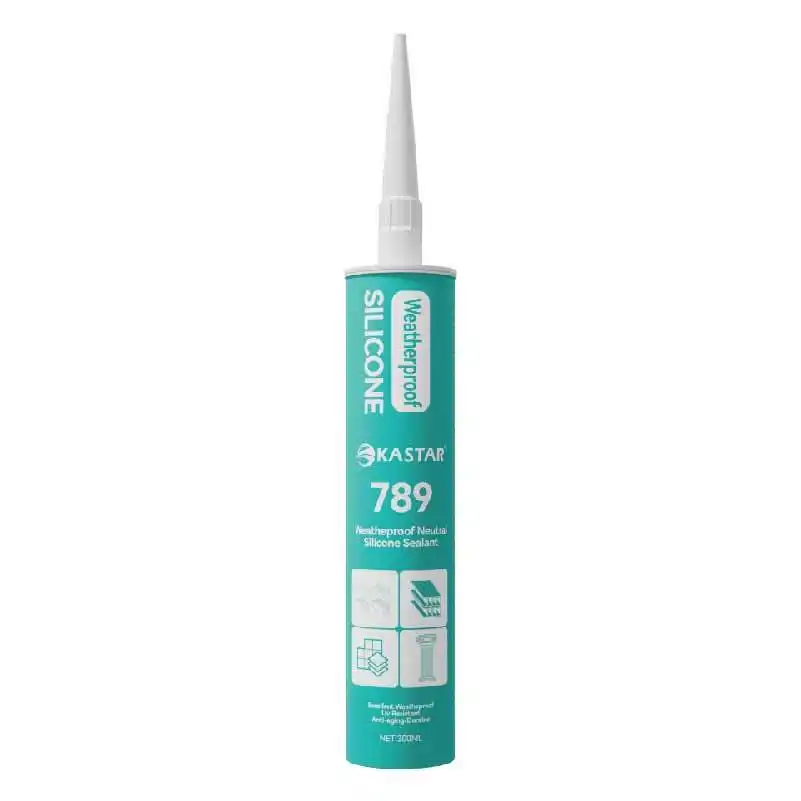
KASTAR provides a comprehensive range of
silicone sealants tailored to diverse sealing requirements. Explore their assortment to find the perfect product for your needs. Discover a wide array of silicone sealant products suitable for various applications. Explore their selection online and find the right sealant for your project!
What are the different types of silicone sealants?
There are several types of silicone sealants available on the market, each with unique properties and applications. Some of the most common types include general-purpose silicone sealants, high-temperature silicone sealants, and low-VOC silicone sealants.
✅ KASTAR789 belongs to RTV-1, with good extrusion, and thixotropy between 40C~400C. Easy to use.
✅ Neutral curing, non-corrosive to metal, coated glass, concrete, marble, and most kinds of plastic, etc.
✅ Quickly speed of curing, excellent adhesion, middle modulus, excellent movement capability.
✅ Excellent resistance to weather.
✅ Excellent resistance to low and high-temperature change. Little changes in performance at -400C ~1500C.
✅ Excellent adhesive to most common building materials, Special materials will have a better adhesive with priming.
✅ Good compatibility with other neutral silicone sealants.
✅ Belong to non-dissolvent products, low vulcanization shrinkage, and green environmental protection products.
✅ NUSEAL789 also is A high-performance sanitary silicone sealant containing anti-fungal compounds to prevent mold growth in areas subject to high humidity levels.
![KASTAR789 silicone sealant]()
Application Standard
| Type |
Neutral |
| Density(g/cm3) |
1.30 |
| Capacity movement |
±30% |
| Skin formation |
10-20 minutes |
| Drying time(2mm/h) |
10-14 |
| Drying(4mm/h) |
18-22 |
| Max. Tensile strength |
1.8 |
| Hardness shore |
22±2 |
| Elongation at Break(%) |
≥450 |
| Modulus Mpa(100%) |
0.60 |
| Application temperature |
-20℃ to +40℃ |
| Temperature resistance |
-50℃ to +100℃ |
Optional Color
Black, white, grey or appointed color of clients
Packing Specification
280ml, 300ml, 310ml (net capacity) hard package or 590ml (net capacity) complex aluminum foil soft package (the actual weight is subject to final products)
KASTAR789 is a neutral RTV-1 silicone sealant suitable for sealing and bonding common building materials such as glass, metal, coated glass, concrete, marble, and most plastics.
What substrates can KASTAR789 be used on, and will it corrode metals?
It is a neutral curing, non-corrosive formula, making it more suitable for substrates that are more sensitive to acidic adhesives, such as metals, coated glass, stone, and most plastics.
How does KASTAR789 perform in low and high temperature environments?
This product is suitable for application temperatures ranging from 4℃ to 40℃. After curing, its performance remains relatively stable within a temperature range of -40℃ to 150℃, making it suitable for applications with temperature variations and outdoor exposure.
What is the difference between acidic and neutral silicone?
Neutral silicone is more suitable for metals, stone, coated glass, and most sensitive materials. It is generally less odorous and non-corrosive. Acidic silicone has a narrower range of applications.
KASTAR Silicone Sealants Manufacturer
Kastar adhesive Co.,Ltd founded in 1997, Kastar is the largest professional OEM & ODM manufacturer of adhesive sealants in China, with 50,000 square meters of factories. Having professional manufacturing equipment and facilities, and with 27 years of experience specializing in construction adhesive sealants and a strict quality control system, we created the top-class KASTAR®.
1. Will silicone sealant mold or age?
High-quality silicone sealants typically have good weather resistance and moisture resistance, but prolonged exposure to damp, dirty, and UV-exposed environments can still lead to aging or mold growth. Choosing the right product and proper maintenance are crucial.
2. Can silicone sealant be used outdoors?
Yes, provided you choose a product with good weather resistance, UV resistance, and temperature difference resistance. These products are more suitable for doors, windows, curtain walls, and exterior wall joints.
3. What should I pay attention to before application?
Before application, ensure the substrate is clean, dry, and free of oil. Determine whether a primer or compatibility test is needed based on the material and application environment.
4. How do I choose the right silicone sealant for my project?
When choosing a silicone sealant, it is essential to consider factors such as the type of surface you will be bonding to, the location of the application, and the expected temperature and weather conditions. You should also consider the cure time, color, and specific properties of the sealant.